Your MCP servers. Every AI client. One click.


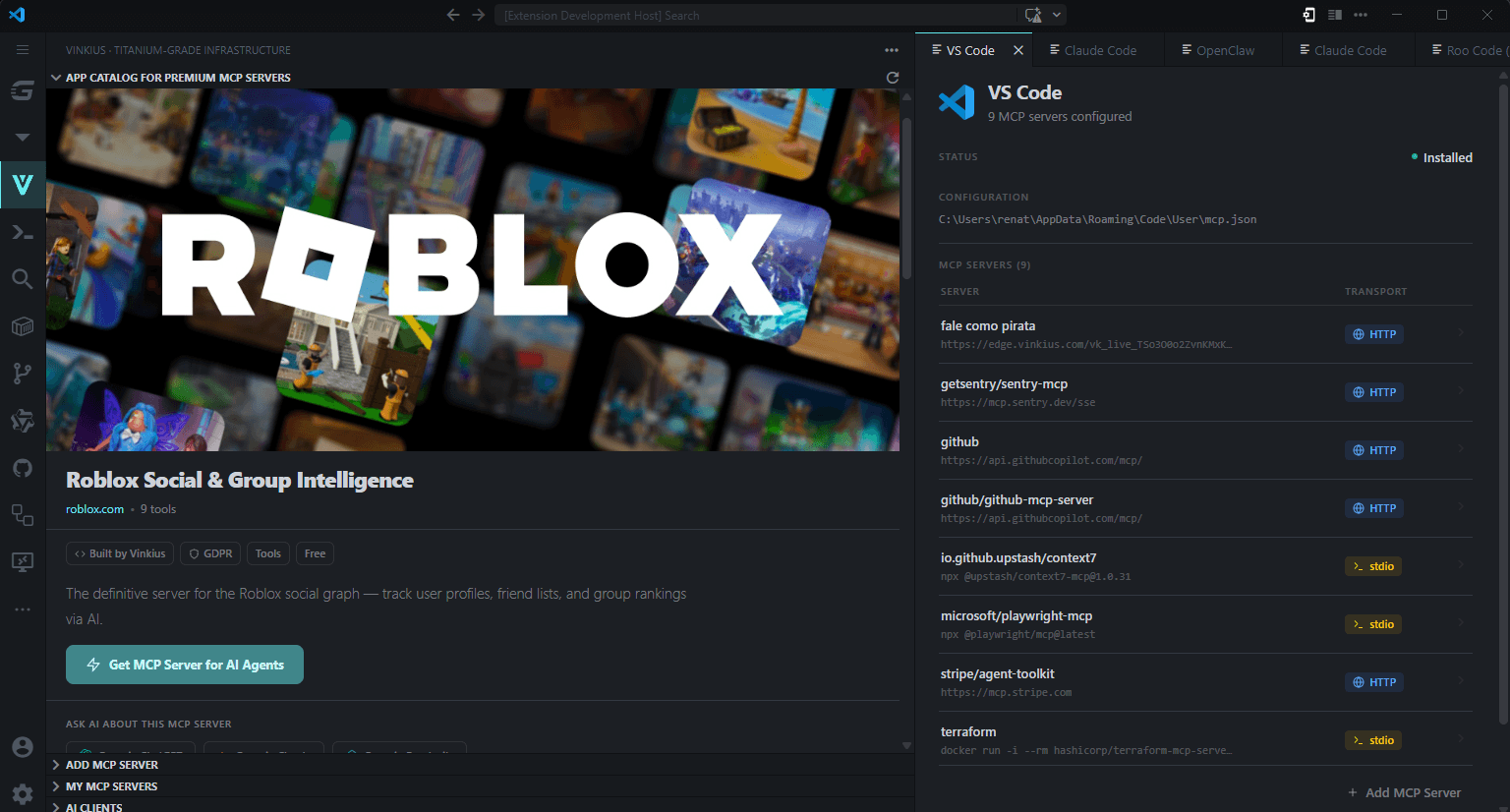
You have Claude Desktop, Cursor, Copilot, Windsurf, VS Code, Gemini CLI, Cline — each one with its own MCP config file, its own JSON schema, scattered across your filesystem. You install a server in Cursor. Then you do it again for Claude. Again for Copilot. Again for Windsurf. Different keys, different paths, different formats. Every. Single. Time.
Vinkius MCP Catalog sees all of them. One sidebar. One control surface. Every MCP server and every AI client on your machine — managed from your editor.
My MCP Servers — the view no one else has
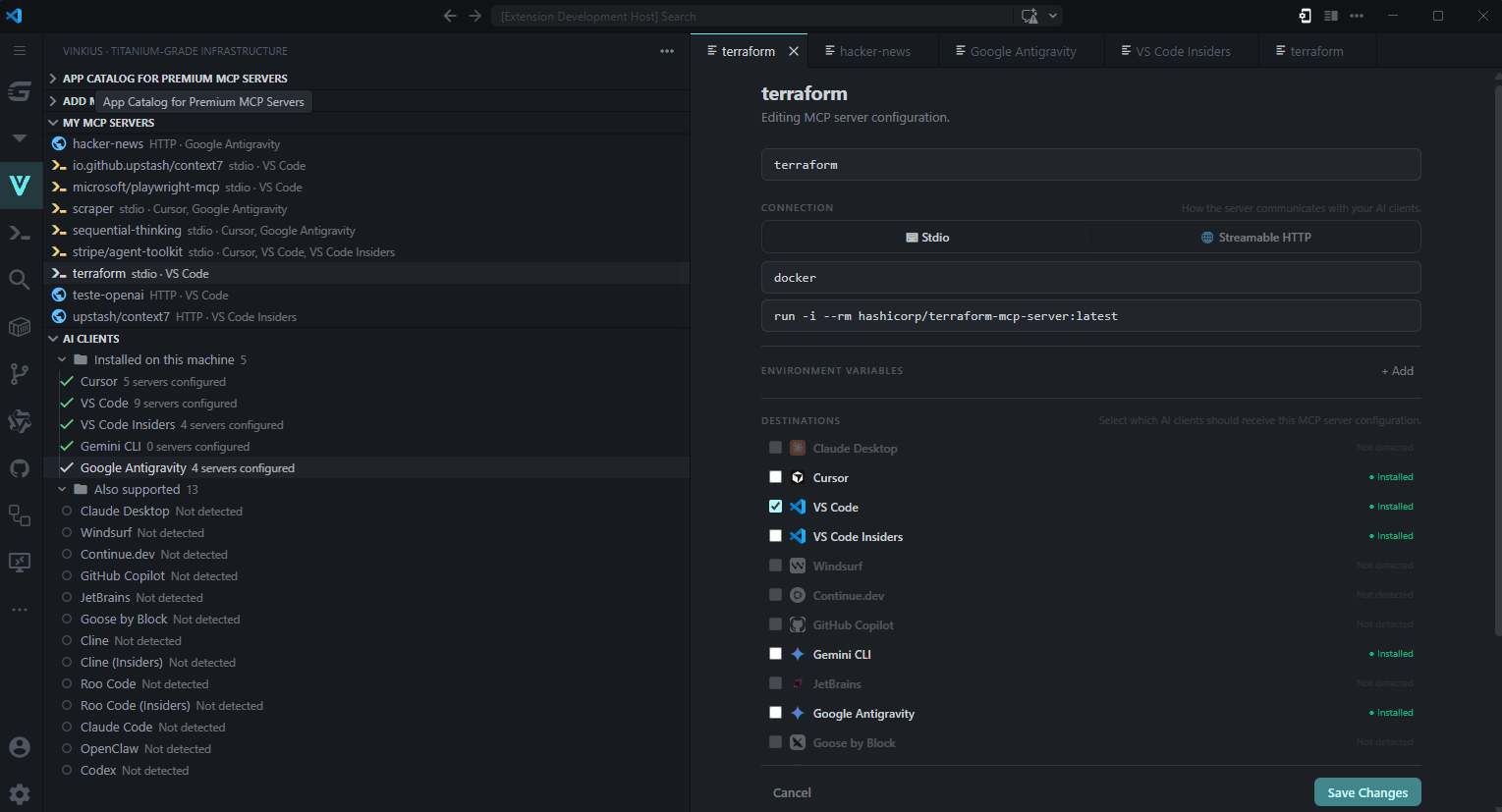
Other extensions let you add a server. Vinkius MCP Catalog shows you every MCP server already configured on your machine — across every AI client simultaneously.
Open the My MCP Servers panel and you see the complete picture:
- A server installed only in Cursor? It's there.
- A server configured in Claude Desktop but not in VS Code? It's there.
- A server you added via Gemini CLI last week? It's there too.
Every server. Every client. One unified list.
Click any server and its full detail panel opens: transport type, connection string, environment variables (masked by default), and exactly which clients have it installed. No more digging through ~/.cursor/mcp.json, ~/.config/claude/config.json, ~/Library/Application Support/Code/User/settings.json — it's all right here.
Hit Edit and you can modify the configuration, change the transport, update environment variables, and add or remove the server from specific clients — all at once. Save, and every selected client receives the updated config in the exact format it expects.
AI Clients — your entire MCP ecosystem at a glance
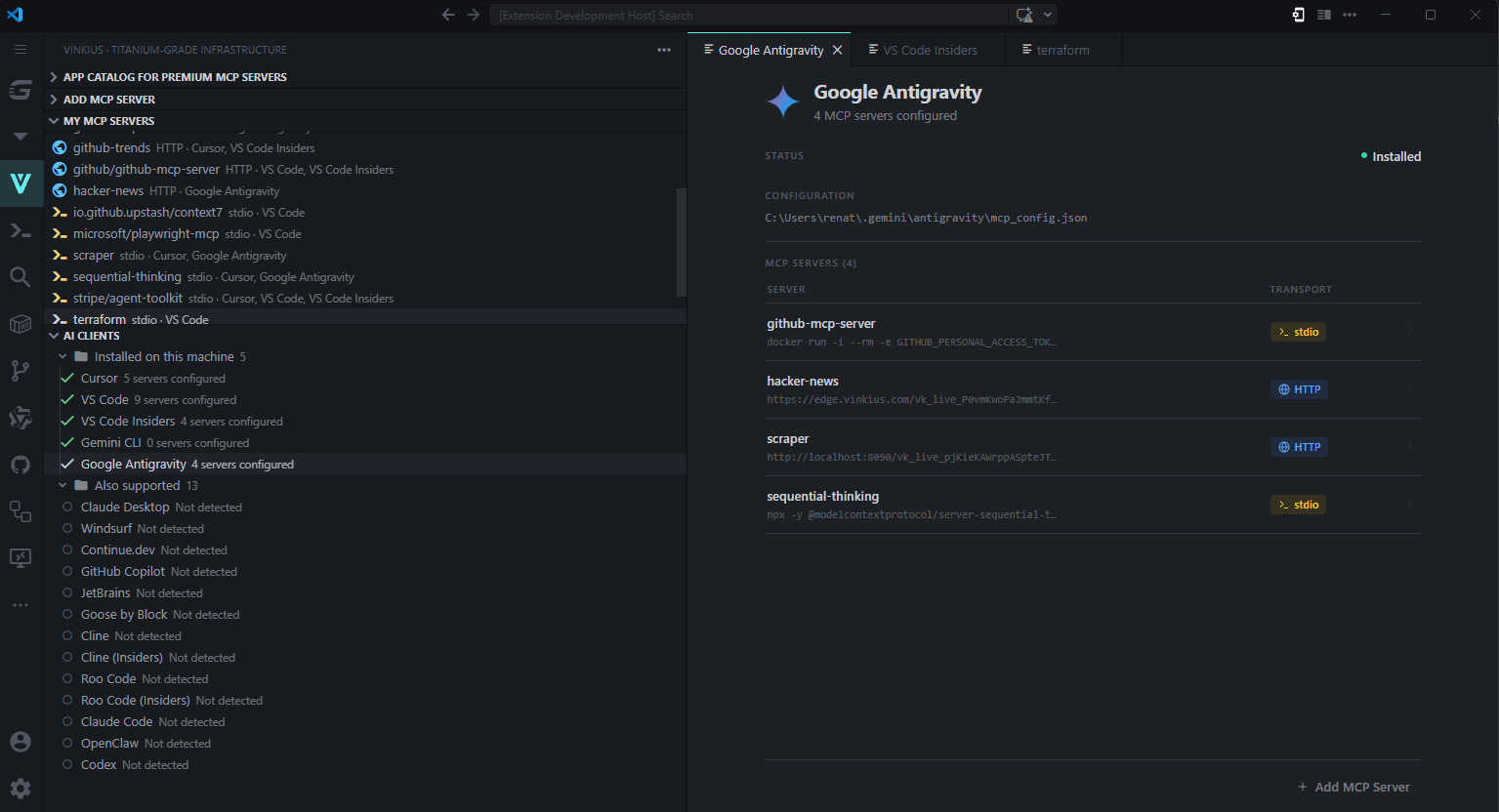
The AI Clients panel does something no other tool does: it auto-detects every MCP-compatible AI client installed on your machine and shows you exactly what's inside each one.
What gets detected
| Category | Clients |
|---|---|
| IDEs | Visual Studio Code · VS Code Insiders · Cursor · Windsurf · JetBrains |
| Agents | Cline · Continue.dev · GitHub Copilot · Google Antigravity |
| Native apps | Claude Desktop · Gemini CLI · Goose by Block |
Each client shows its detection status and a count of installed MCP servers. Click any client and you see:
- Every MCP server configured in that client
- The config file path and format
- Connection details for each server
This is the control plane that was missing. You finally know exactly what's installed where, without opening a single JSON file.
App Catalog — browse and install in seconds
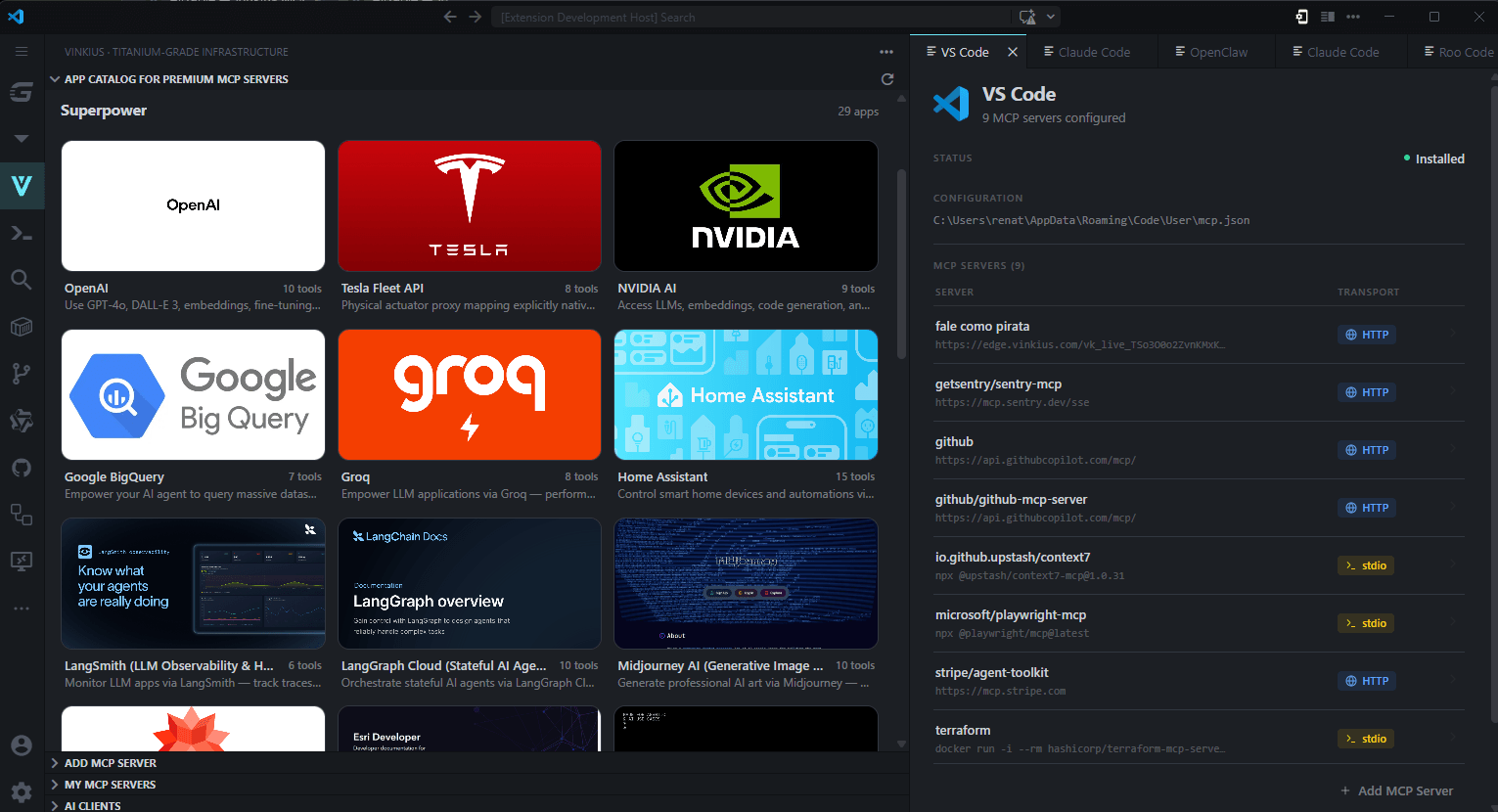
A built-in marketplace with hundreds of MCP servers from the Vinkius registry. Search by name, browse by category, see descriptions and capabilities.
When you find what you need:
- Click Install
- Select your target clients (Claude, Cursor, Copilot, Windsurf — as many as you want)
- Done. The extension writes the correct config, in the correct format, at the correct path, for every selected client.
One action. All clients updated simultaneously. No settings.json editing. No copy-pasting JSON blocks between files.
MCP Introspection — see what a server can do
Click ⟳ Discover on any server and the extension connects via JSON-RPC 2.0, performs the full MCP handshake, and lists every capability the server exposes:
| Capability | What you see |
|---|---|
| Tools | Function name and description for every tool the server provides |
| Resources | URIs and descriptions of available data resources |
| Prompts | Named prompt templates and their arguments |
Supports both stdio (local commands) and Streamable HTTP (remote servers, with SSE fallback) transports. Works with any MCP-compliant server.
Full capability matrix
| Feature | Description |
|---|---|
| Unified server view | See every MCP server on your machine, regardless of which client it belongs to |
| Multi-client auto-detection | 12+ AI clients detected automatically with config path resolution |
| Simultaneous deployment | Install or update a server across all selected clients in one action |
| Inline editing | Edit server config, transport, env vars, and client targets without leaving the panel |
| JSONC-safe writes | Production-grade parser that preserves comments, trailing commas, and file formatting |
| Capability introspection | Discover tools, resources, and prompts via live JSON-RPC 2.0 connection |
| Transport handling | Automatic resolution of stdio and Streamable HTTP/SSE transports |
| Theme-aware UI | Adapts seamlessly to VS Code light and dark themes |
Getting started
Install → Search Vinkius MCP Catalog in the Extensions panel (Ctrl+Shift+X), or:
ext install vinkius.ide-catalog
The Vinkius icon appears in your Activity Bar. Click it. Your installed MCP servers and detected AI clients are already there — no setup, no configuration, no account required.
Why this exists
MCP made every API accessible to every AI agent. But the configuration layer is still fragmented — 12 clients, 12 config files, 12 different JSON schemas, scattered across your filesystem.
My MCP Servers and AI Clients are the solution: a single control surface that reads, writes, and synchronizes every client's configuration from one place.
Pair it with Vinkius Desktop for full system-wide management outside the IDE, or use the Vinkius Cloud gateway for production deployments with DLP, token gating, and observability.
Requirements
- VS Code 1.80+, Cursor, Windsurf, or any compatible IDE
- No account required — free and open source
Contributing
See CONTRIBUTING.md for development setup, project structure, and guidelines.
git clone https://github.com/vinkius-labs/mcp-catalog.git
cd mcp-catalog && pnpm install && pnpm run dev
License
Apache 2.0 — built by Vinkius Labs.